 Automation
Almost every company has more processes to automate than it can handle at once. The common mistake is to start with the biggest or the most visible one. It pays to start with the one that repeats most, has clear rules and takes hours from your team today. These are the signs for spotting it.
In short
Automate first the processes that are repetitive, have clear rules, use orderly data and force people to enter the same thing twice. Wait on those that change often or depend on a person's judgment. A good first project is small, measurable and works on the systems the company already uses.
Automating a process means making information move on its own from one system to another: no copying, no pasting and no data-entry errors. The hard question is not whether it can be done. It is which one to start with.
Five signs a process is ready
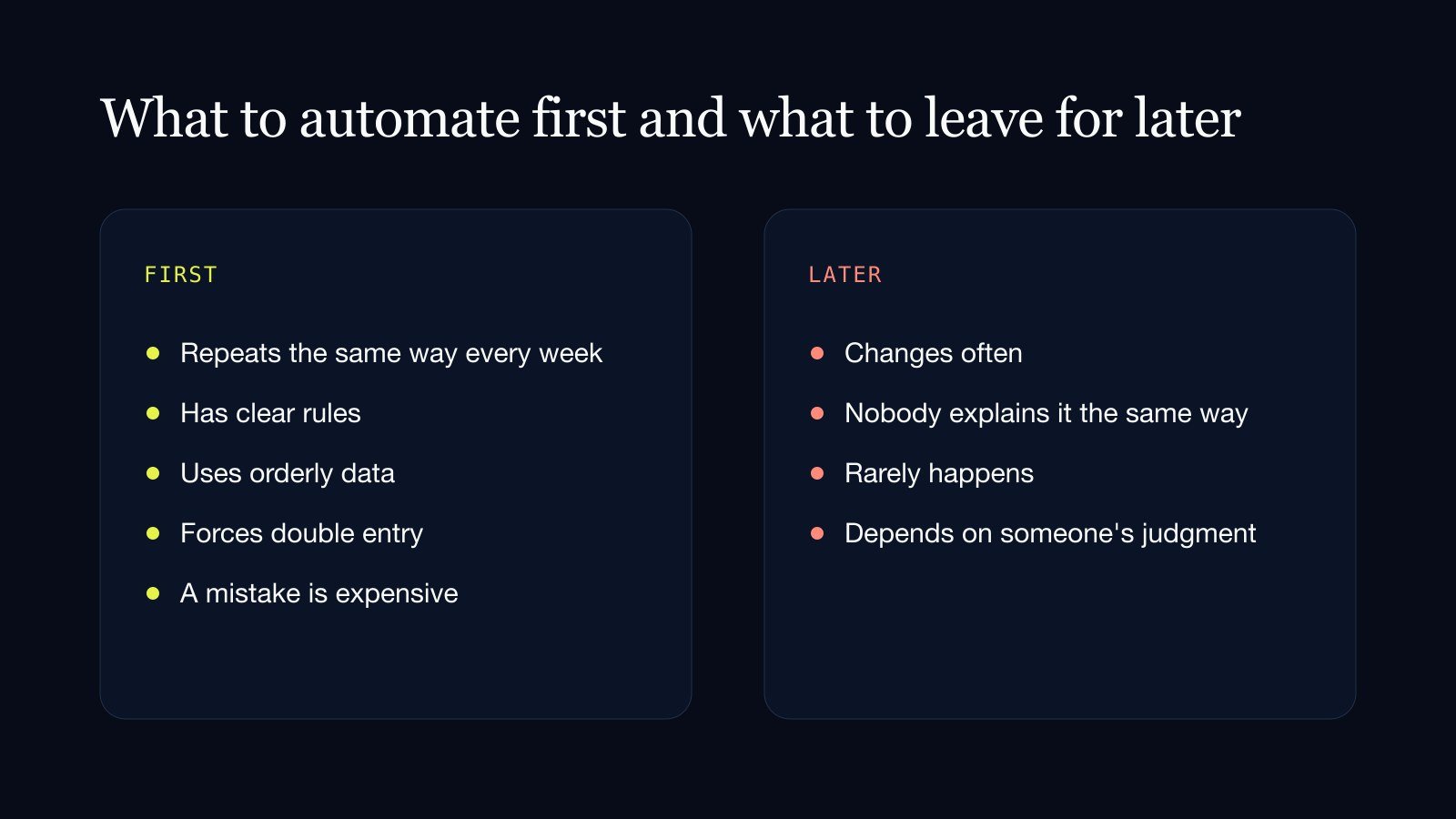
- It repeats the same way every week. If someone does the same thing every Monday, it can almost certainly be automated. The more often it happens, the sooner the change shows.
- It has clear rules. "When an order comes in, it is logged and the warehouse is notified" is a rule. "It depends on the customer" is not one yet.
- It uses orderly data. An automation works with what it finds. If the data lives in a system or in a well-kept spreadsheet, there is something to start with.
- It forces double entry. This is the easiest sign to see: the same information is typed into the CRM, then into a spreadsheet, then into the invoice.
- A mistake is expensive. A miscopied figure in a payroll run or an invoice costs time, money and trust.
The processes that usually meet these signs are order entry, invoicing, payment reconciliation, payroll, reports and notices to customers or to the team.
What to leave for later
Some processes can be automated, but not first:
- Those that change often. If the way of doing it is redefined every month, it needs to settle first.
- Those nobody can explain. If two people do it differently, agreement comes before automation.
- Those that rarely happen. Something that occurs twice a year seldom justifies the effort.
- Those that depend on judgment. Negotiating with a customer or handling a delicate complaint is still work for people.
One nuance: AI has widened what belongs on the first list. Today it can read documents, classify emails or messages and decide where each piece of data goes. Processes that used to need someone to read and decide can now be automated.
What a good first project looks like
- It is small. One complete process, not five half-done.
- It can be measured. Before starting, it should be clear what will change: hours, errors or response time.
- It works on what you already have. Changing systems is almost never necessary. Automation connects your ERP, your CRM and your spreadsheets.
- It knows what to do when something fails. If a system does not respond, it should hold what is pending and retry, not lose the information.
A real example
A coffee shop chain calculated its payroll by hand, in spreadsheets, with attendance issues arriving late from each branch. It met every sign: it repeated every period, had clear rules, was entered twice and a mistake was expensive.
The whole process was automated, from attendance at each branch to the payslip. Today it is a single flow for all branches, with no double entry.
Where to start this week
List what your team does the same way every week. Mark the processes where someone copies data from one place to another. Of those, pick the one that takes the most hours. That is your candidate.
At Vilo AI Studio, that work happens in Discovery: it takes two to three weeks and defines what to automate first. Development is done in stages, so the first processes are running before the whole project is finished.
See Vilo AI Studio's process automation service.
What task does your team do every week, exactly the same way, that nobody asks anymore whether it could run on its own?
Get in touch Artificial intelligence
 Software