 Artificial intelligence
NVIDIA makes the chips used to train and run almost every AI model, including those from OpenAI and Anthropic. It is one of the most valuable companies in the world. Between November 8 and 12, 2026, it lost its founder and CEO, Jensen Huang. There is a lot of noise around this story: here we separate what is confirmed from what has only been reported.
In short
NVIDIA announced on November 12, 2026, that Jensen Huang had resigned as CEO, four days after the board opened an independent investigation. Chief financial officer Colette Kress is interim CEO. For a company that uses AI, the tools keep working the same way; the lesson is about governance and about not depending on one person or one supplier.
What happened, day by day
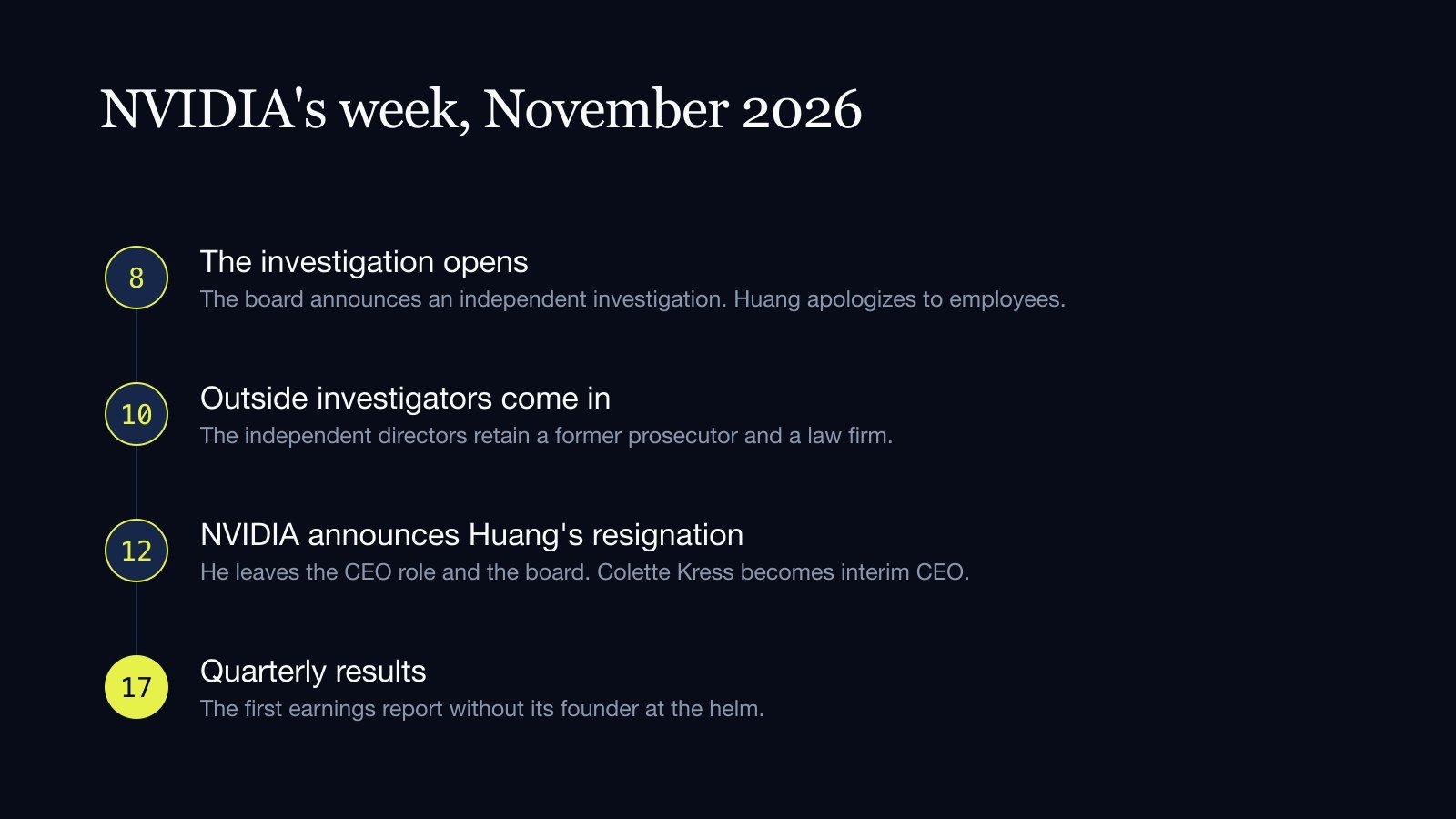
Sunday, November 8. NVIDIA's board of directors announced an independent investigation following press reports that Jensen Huang had been the target of a foreign intelligence effort. In that statement, the board expressed its confidence in him.
That same day, Huang sent a message to employees. He acknowledged being unfaithful to his wife, apologized and said he would cooperate with the investigation.
Tuesday, November 10. The independent directors retained a former federal prosecutor and an outside law firm to run the investigation.
Thursday, November 12. NVIDIA announced that Huang resigned as president, CEO and member of the board, effective immediately. The release does not include any statement from him. According to the document the company filed with the securities regulator, the board accepted the resignation a day earlier, on Wednesday the 11th.
The company named Colette Kress, its chief financial officer since 2013, as interim CEO. Kress keeps her finance role as well. Harvey C. Jones was named chair of the board, a position NVIDIA had not had before. The board began the search for a permanent successor among internal and external candidates.
What is confirmed and what is not
Confirmed by NVIDIA or by Huang himself:
- The independent investigation and who is running it.
- Huang's message to employees and his apology.
- The resignation, the interim CEO and the new board chair.
- That the board accepted the resignation on November 11, a day before announcing it.
- That the board said it has no reason to believe national security or NVIDIA's secrets were compromised.
Reported by the press and not confirmed by NVIDIA:
- The New York Times and Reuters reported relationships between Huang and people who work at the company.
- The New York Times and CNBC reported that a businesswoman linked to him is alleged to be a possible asset of Chinese intelligence.
- CNBC reported, citing an anonymous source, that it was the board that decided on Huang's departure.
No one has presented public evidence of espionage. The investigation has produced no findings and has no delivery date. Until that happens, the second list is reports, not facts.
The reaction
In Washington, the chair of the Senate Banking Committee asked Huang to testify in December, and Democratic lawmakers called for a review of approvals for chip exports to China, according to CNBC.
On the stock market, NVIDIA shares closed down 4.3% on Thursday after hitting a 52-week low during the session, also according to CNBC. Analysts are split: some cut their price targets and others argue the business has not changed.
What comes next
- Tuesday, November 17: NVIDIA reports quarterly results, on the date that was already scheduled. It will be the first earnings report without Huang at the helm.
- The search for a successor: it has no deadline. Names have been floated in the press; none is confirmed.
- The investigation: the board said it will provide updates as appropriate.
The new board chair said he expects operations, customer commitments and product plans to continue without interruption.
What it means for your business
In the short term, nothing changes. If you use ChatGPT, Claude, Gemini or any AI tool, it keeps working the same way. The chips that make it possible are already built and installed, and NVIDIA's contracts with its customers remain in force.
In the medium term, watch two things. The first is who ends up running the company and whether they keep up the pace of new chips. The second is whether the United States tightens export rules. Both can move the price and availability of computing capacity, and that ends up in the price of AI tools.
The underlying lesson is not about technology. NVIDIA is an extraordinary company that, in the eyes of the market, depended on one person. That is the part that applies to any business:
- Do not depend on one person. If a key process in your company lives in someone's head, document it and automate it.
- Do not depend on one supplier. When implementing AI, your systems should be able to switch models without being rebuilt from scratch.
- Decide on facts, not headlines. Do not pause or rush an AI project because of this news. What matters is whether it solves a real problem in your operation.
At Vilo AI Studio we design projects so they do not depend on a single tool or a single person.
That is how we approach custom software: once the project is paid in full, the code belongs to your company.
Sources
- NVIDIA: CEO transition announcement
- NVIDIA: statement from the Board of Directors
- NVIDIA: statement from the independent Board members
- NVIDIA: a message to the company
- NVIDIA: filing with the SEC (Form 8-K)
- CNBC: live coverage, November 12, 2026
- Yahoo Finance: live coverage
If the key person in your company were gone tomorrow, which process would stop?
Get in touch Artificial intelligence
 Artificial intelligence