 Artificial intelligence
On November 5, 2026, Anthropic launched Personal Finance in Claude. You connect your bank accounts and cards, and ask Claude where your money went. For now it only works in the United States, but it shows clearly where AI is heading: from answering general questions to working with your own data.
In short
Personal Finance is a beta feature that connects your bank accounts to Claude to analyze your spending. It is read-only: it does not move money or give investment advice. It is available on Claude's paid plans in the United States, with no date yet for other countries. For a company in Mexico, the lesson is to get its data ready: the same idea is coming to business finances.
Until now, getting help from AI with your finances meant pasting in your transactions or uploading a statement. With Personal Finance, Claude connects directly to your accounts and answers with your real numbers.
What Personal Finance in Claude is
Personal Finance is a new section in Claude where you connect your bank accounts and credit cards. From there you can ask about your money in plain language, with no formulas or spreadsheets.
The examples Anthropic gives are everyday questions:
- "Where did my money go this month?" Claude totals your spending by category.
- "Is that more than usual?" It compares against your previous months.
- "What's left before payday?" It subtracts the payments coming up.
- "Which subscriptions am I paying for?" It lists them.
Beyond answering, Claude builds weekly spending charts, a calendar of bills and a dashboard you can edit, with your subscriptions, upcoming bills and budgets. It also flags duplicate charges, unexpected fees and bills that keep rising.
How it connects to your bank
The connection runs through Plaid, a service used by many financial apps in the United States. You sign in on Plaid's screen, not in Claude, so Claude never sees your bank password. You can connect up to 16 banks.
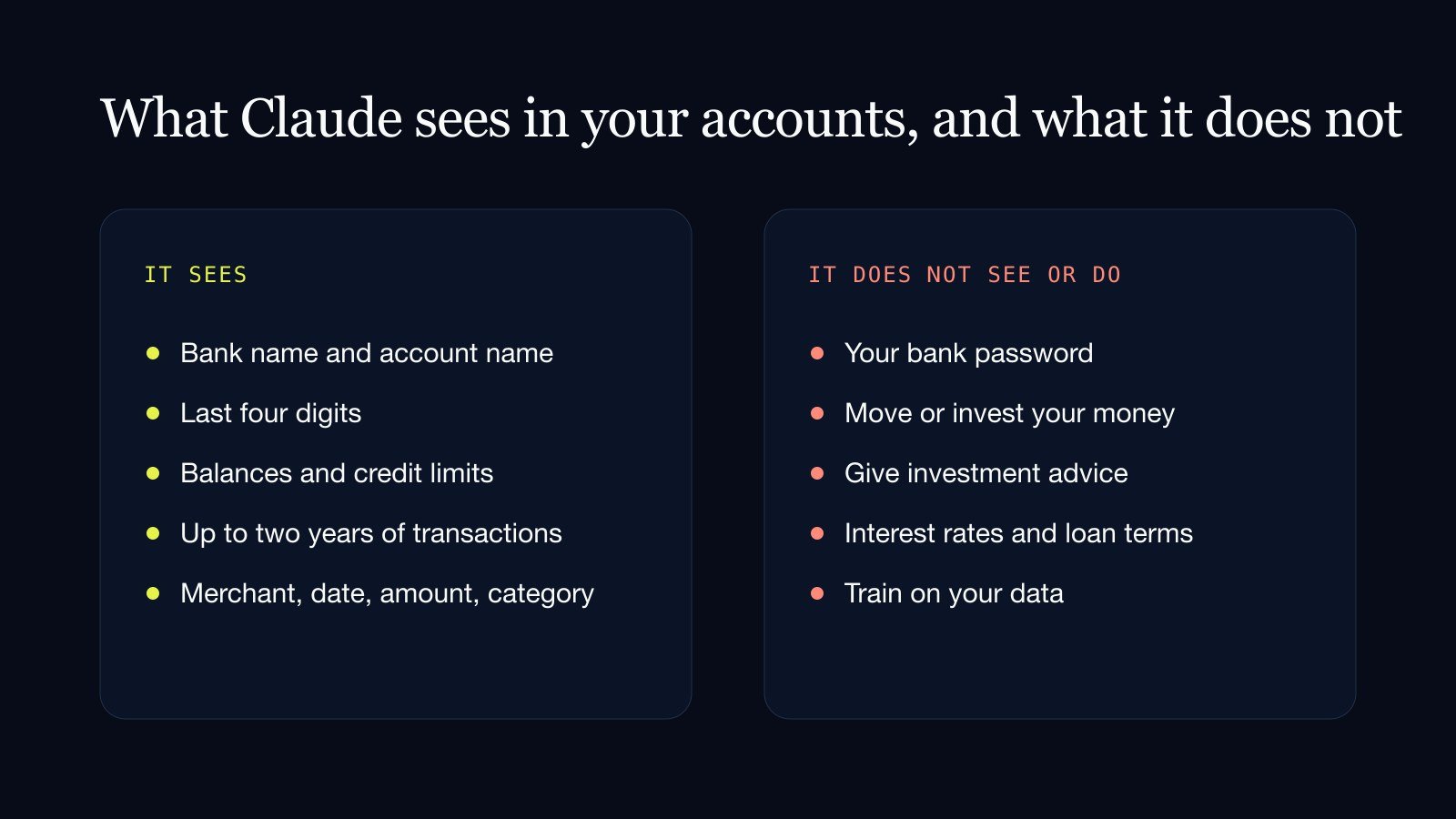
For each account, Claude sees the bank name, the account name and type, the last four digits, balances, credit limits and up to two years of transactions. For each transaction it sees the amount, date, merchant and category.
What it cannot do
Access is read-only. Anthropic is clear on three points:
- It does not move money. It cannot transfer, pay or invest.
- It does not give investment advice. It is not designed to tell you what to invest in.
- It does not sell financial products. It offers no cards, loans or accounts of its own, and has no ads.
It also warns that Claude can make mistakes. Balances may be a day or two old, and if you do not connect all your banks, the spending total is incomplete and a budget can say you have more left than you do. The recommendation is to check the figures against your bank before deciding anything.
What happens to your data
This is the most important question, and the answer has nuances:
- Personal Finance conversations are not used to train the models.
- They are not saved to Claude's memory and do not appear in its monthly recap.
- The figures do stay in the chat history until you delete it.
- Unlinking a bank cuts off access, but does not delete answers, dashboards or links you already shared.
One practical detail: if you cancel your paid plan, the banks stay linked. Anthropic recommends unlinking them first.
Who can use it today
Personal Finance is in beta and rolling out gradually. These are its current limits:
- Plans: Pro, Max and Ultra. It is not on the free plan or on Team and Enterprise.
- Country: United States only, and only US banks. Elsewhere the feature does not appear, even with a VPN.
- Cost: no extra charge beyond the subscription.
There is no date for other countries and no source mentions Mexico.
Claude is not the first
ChatGPT launched personal finance tools in May 2026, also connected through Plaid. According to DataCamp's analysis, the main difference is privacy: Anthropic does not train on these conversations and says there will be no ads.
That the two largest AI companies launched the same thing six months apart says something: connecting AI to each person's real data is now the direction of the market, not an experiment.
What it means for your business
Personal Finance is for individuals, not businesses, and it has not reached Mexico yet. Even so, it leaves three lessons for any company:
- AI is more useful when it has your data. A model that only knows what is on the internet gives general answers. One that reads your transactions tells you which charge was duplicated. The same goes for your sales, your inventory or your collections.
- Your data has to be in order. Claude can read a bank because transactions arrive clean: date, amount, merchant, category. If your company's information lives in loose spreadsheets and chats, no AI will be able to work with it.
- Read-only first. Anthropic started with the safe part: seeing without being able to move. That is a good order for any AI project: first it looks and alerts, then it acts.
There is no need to wait for this feature to reach Mexico. Connecting AI to a company's systems, with read-only permissions and clear rules, is already possible today.
That is how the AI agents for businesses built by Vilo AI Studio work: connected to your systems, with clear permissions and rules.
Sources
- Anthropic: introducing Personal Finance in Claude
- Claude Help Center: using Personal Finance
- TechCrunch, November 5, 2026
- MacRumors, November 5, 2026
- DataCamp: Personal Finance analysis
- Notebookcheck: what the AI sees in your bank account
What would you ask an AI that could read your company's numbers, today?
Get in touch Artificial intelligence
 Artificial intelligence