 Websites
Not long ago, someone looking for a provider typed into Google and checked ten links. Today many ask ChatGPT, Claude or Gemini directly and get a single answer, with two or three names. If your company is not among them, it does not exist in that conversation. Showing up there has a name: AEO or GEO. And the work starts on your website.
In short
AEO and GEO are the practices that get AI assistants such as ChatGPT, Claude or Gemini to cite and recommend a company. They do not replace SEO: they build on it. The foundation is a site that says clearly what the company does, where and for whom, that answers real questions and that AI can read without obstacles. Nobody can guarantee a recommendation, but you can stop being invisible.
AI assistants answer in two ways: with what they learned in training and with what they find when searching the internet at that moment. In both cases, your website is the main source of what they know about you.
What AEO and GEO are
AEO stands for Answer Engine Optimization. GEO stands for Generative Engine Optimization. In practice they are used for the same thing: getting an AI to mention you when someone asks it a question about what you sell.
How it differs from SEO
- SEO aims for a position. You want to appear at the top of a list of links.
- AEO aims for a mention. You want the answer to include your name, or to cite your page.
They do not compete. A site that is slow, has no clear titles or cannot be read by search engines is no use to an AI either. SEO is the floor; AEO is built on top.
The difference lies in how your content is read. A search engine ranks pages. An AI pulls sentences to build an answer. That is why text that makes sense on its own, without context, wins.
Five changes that make your site citable
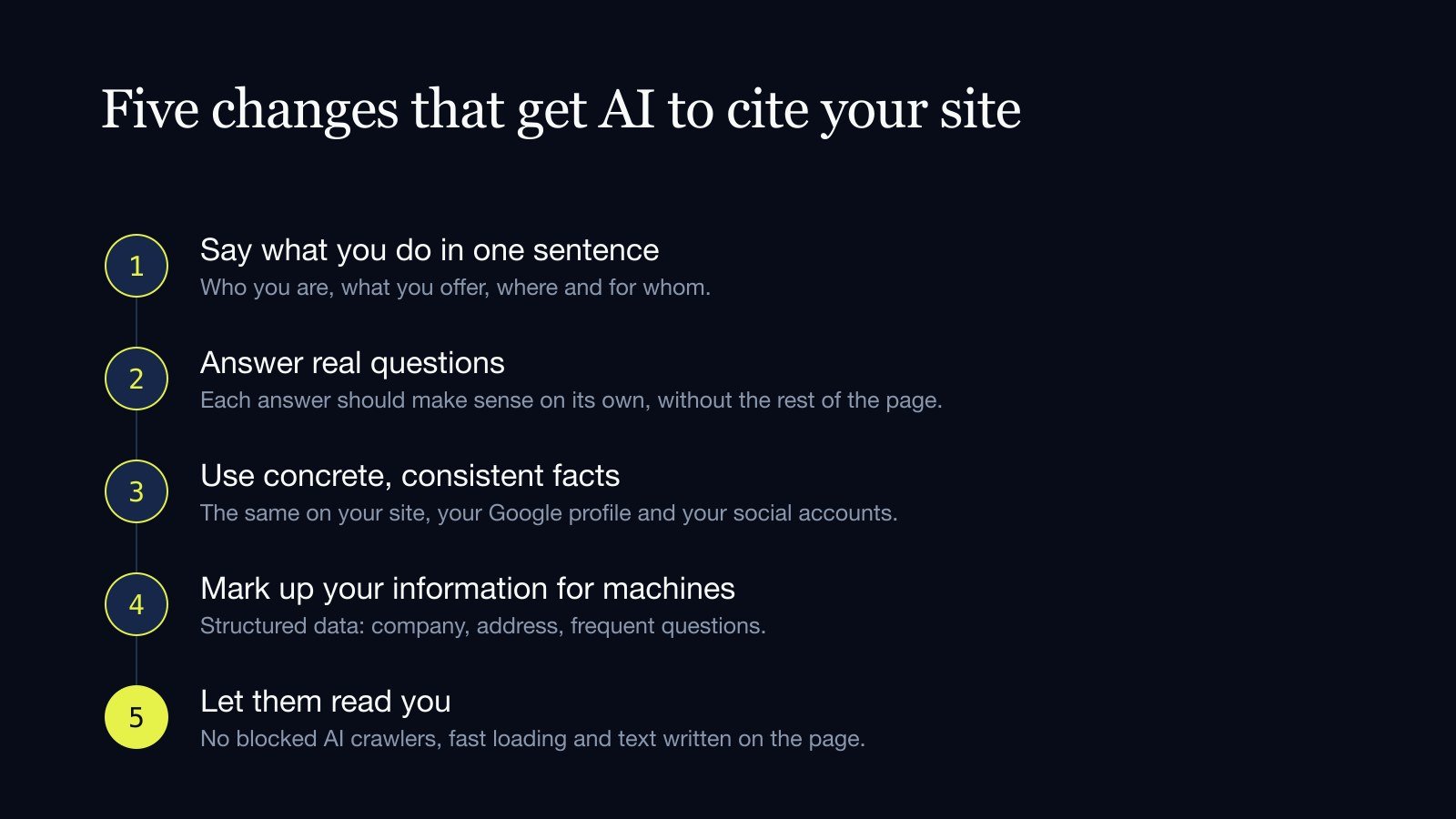
- Say what you do in one sentence. Who you are, what you offer, where and for whom. "Cutting-edge end-to-end solutions" tells nobody anything. "Accounting firm in Mérida for small businesses" does.
- Answer real questions. The ones your customers ask before buying: how long it takes, what the price depends on, what is included. Each answer should make sense on its own, without reading the rest of the page.
- Use concrete, consistent facts. Years of experience, service area, hours, ways to get in touch. And make them the same on your site, your Google profile and your social accounts.
- Mark up your information for machines. Structured data (schema.org) tells search engines and assistants what each thing is: this is the company, this is its address, these are its frequent questions.
- Let them read you. Check that your site does not block AI crawlers, that it loads fast and that the important text is written on the page, not inside an image.
What we did on our own site
On the Vilo AI Studio site we applied these five points:
- Each service opens with a sentence that defines it plainly.
- Each service page has its own frequent questions, with answers that stand on their own, declared as structured data.
- Company details (location, hours, contact) are marked up with schema.org.
- We publish an
llms.txtfile: a plain-text summary of the site, written for AI models. - The site exists in Spanish and English, with each page linked to its version in the other language.
A note on llms.txt: it is a proposed convention, not a standard. Not every model reads it. It costs little to make and does no harm, but it does not replace the other four points.
What nobody can promise you
No AI company publishes how it chooses whom to recommend, and answers change from one question to the next. Anyone who guarantees "first place on ChatGPT" is selling something they do not control.
What you can do is stop being invisible: so that when an AI looks for information about what you do, it finds your site, understands it and has something clear to cite.
How to find out where you stand today
Run the test. Ask ChatGPT, Claude and Gemini what a customer of yours would ask: "which companies do this in my city?". Then ask them directly about your company.
If you do not show up, or what they say about you is incomplete or wrong, you know where to start: it is almost always the first sentence of your home page.
That work starts on your website: see Vilo AI Studio's websites and apps service.
If you ask an AI today about companies like yours in your city, does your name come up?
Get in touch Artificial intelligence
 Software