 Artificial intelligence
On November 9, 2026, Anthropic launched Claude Fable 5.2, its most capable model available to the public. It is up to 30% faster than the previous version and costs 20% less. The news matters less for the numbers than for what it confirms: models can now sustain long stretches of real work, and choosing which one to use has become a business decision.
In short
Claude Fable 5.2 is the most advanced model Anthropic offers to the public, built for long, complex technical work. It is faster and cheaper than Fable 5.1 and, according to Anthropic, much better at business process automation and at reading charts. Anthropic itself recommends starting with Opus 5.5 for most work. For a company, the lesson is to choose the model by the task, not because it is the newest.
Every few months a "smarter" AI model comes out. The useful question for a company is not which one is best, but what each one is for and what it costs to use. With Fable 5.2 that question has a clearer answer than usual.
What Claude Fable 5.2 is
Fable 5.2 is the most capable model Anthropic makes available to the public. The company describes it as a model for ambitious, open-ended technical work: coding, science and finance.
The Claude family now has four tiers:
- Fable 5.2: the most capable, for long and difficult tasks.
- Opus 5.5: the everyday model. Anthropic recommends starting here for most work.
- Sonnet 5.5 and Haiku 5.5: more affordable, for simple or high-volume tasks.
That detail matters: the very company selling Fable says it is not the starting point for almost anyone.
What improved over the previous version
According to Anthropic, Fable 5.2 delivers its answers up to 30% faster than Fable 5.1 and spends less on equivalent tasks.
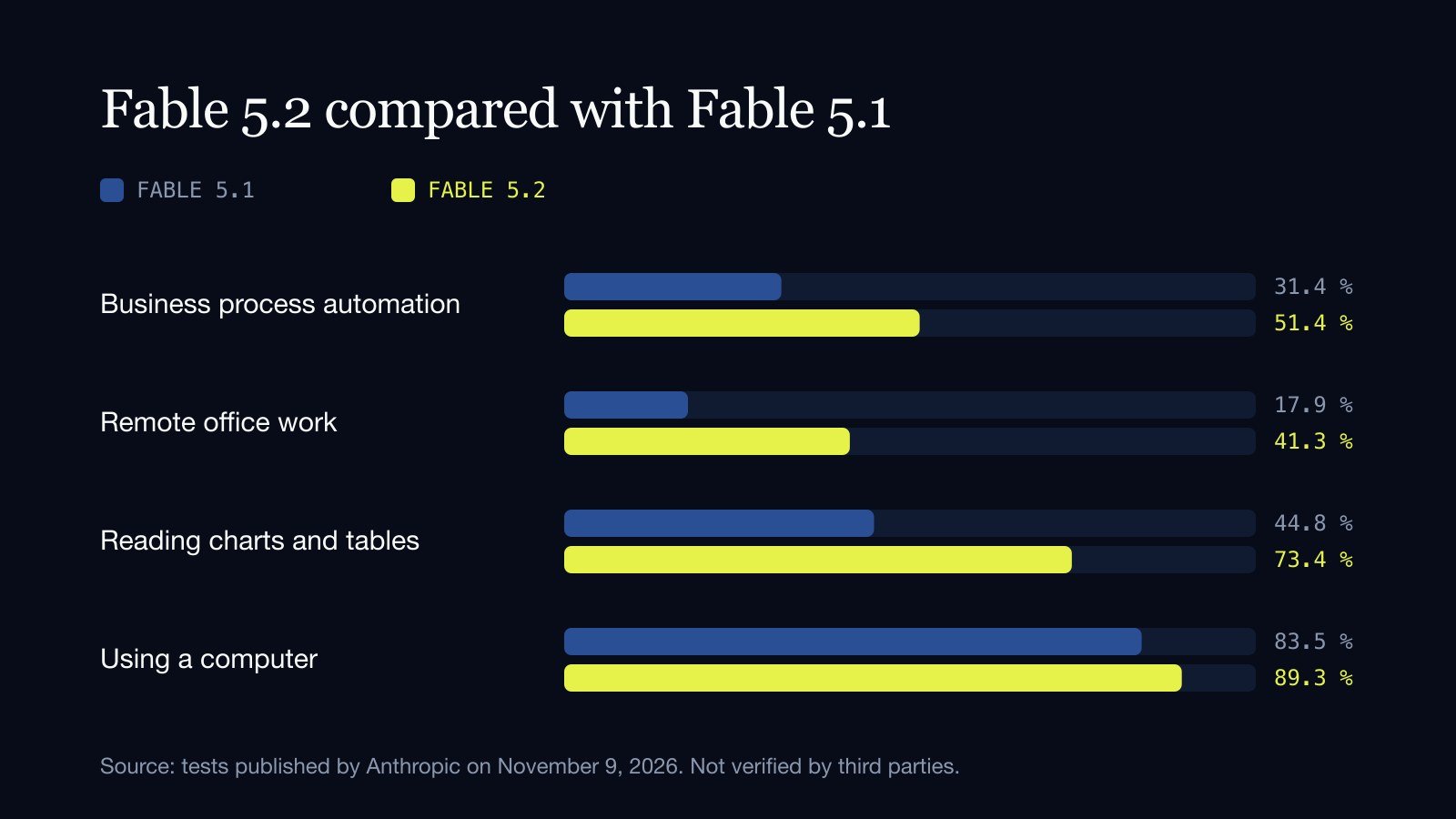
In its tests, the biggest gains are in areas a company cares about:
- Business process automation: from 31.4% to 51.4%.
- Remote office work: from 17.9% to 41.3%.
- Reading charts and tables: from 44.8% to 73.4%.
- Using a computer (opening programs, filling in forms): from 83.5% to 89.3%.
These figures need careful reading. They are tests designed and measured by Anthropic, not by third parties. And even on the best reading, 51% in automation means the model still fails half of the hard tasks in that test. It has come a long way, but it does not work alone.
What it costs
Fable 5.2 came down in price. For those who connect it to their own systems, it costs 8 dollars per million input tokens and 40 dollars per million output tokens. Fable 5.1 cost 10 and 50. A token is, roughly, a piece of a word.
For those who use Claude through the app, Fable 5.2 is included in the paid plans: Pro, Max, Ultra, Team and Enterprise. It is also available on the Amazon, Google and Microsoft platforms.
Anthropic adds a useful data point for deciding: at high effort, Fable 5.2 achieves a coding result similar to Opus 5.5 at about half the cost per task. In other words, the most advanced model is sometimes cheaper, because it gets there in fewer attempts.
Fable and Mythos: the same model with different locks
Claude Mythos 5.2 came out alongside Fable. Anthropic explains that they are the same model. The difference is that Fable has safeguards in two areas, cybersecurity and biology, and Mythos does not.
The reason is the risk of misuse. A model that capable in those areas could help create wide-reaching cyberattacks. That is why Mythos is only available to verified organizations working in security or life sciences.
In Fable, high-risk queries on those two topics are blocked and passed to an earlier model. Anthropic says this version blocks about 55% less than Fable 5.1, meaning it gets in the way of legitimate work less often.
What companies are using it for
The announcement includes cases from companies that tested it before launch. Two help show the kind of work:
- Box said the model reviewed a loan file and spotted that the salary deposits did not match the bank balance.
- Uber used it in a 10 to 12 hour security audit, coordinating about 170 reviewer agents.
Both cases have something in common: they are long tasks with many steps, where a mistake halfway through ruins the result. That is where a more capable model pays for itself.
What it means for your business
For most companies, Fable 5.2 does not change what they do tomorrow. It changes how to decide:
- Choose the model by the task. Answering an email or summarizing meeting notes does not need the most expensive model. Reviewing a hundred contracts or coordinating a process that runs for hours does.
- Measure cost per finished task, not per query. A cheap model that needs five attempts can cost more than an advanced one that gets it right the first time.
- Do not tie your system to a single model. Models are replaced every few months. A well-built agent or automation should be able to switch models without being rebuilt.
- Be wary of figures without context. Vendor tests are a guide, but the only test that counts is yours: your documents, your processes, your customers.
At Vilo AI Studio we work with Claude every day and choose the model based on what each project needs. Most of the agents and automations we build do not require the most expensive model, and that shows in what they cost to run.
See how we build AI agents for businesses with Claude.
Sources
- Anthropic: announcing Claude Fable 5.2 and Mythos 5.2
- Anthropic: Claude Fable product page
- MacRumors, November 9, 2026
- Yahoo Finance
Which task in your company is long and delicate enough to be worth giving to the most capable model?
Get in touch Artificial intelligence
 Artificial intelligence